Thumbnail_GeneticLIMS_CCRI

The world of laboratory diagnostics and biomedical research is undergoing a revolution through the use of advanced technologies such as laboratory information and management systems (LIMS). A notable example of this development is the introduction of the DORNER Genetics LIMS at LabDia Labordiagnostik and the St. Anna Children's Cancer Research Institute in Vienna. 

This blog post highlights how St. Anna Children's Cancer Research Institute (CCRI) and LabDia Laboratory Diagnostics have revolutionized their work processes by integrating an advanced LIMS.

Integration and efficiency with DORNER Genetics LIMS

The main goal of LabDia LaborDiagnostik is to create a comprehensive system that brings together the various specialist departments - including hematology, oncology, infectiology, human genetics and immunology. The DORNER Genetics LIMS enables them to efficiently manage sample tracking, shared reporting and access to results from other departments.

Challenges and solutions at the St. Anna Children's Cancer Research Institute

The St. Anna Children's Cancer Research Institute, known for its groundbreaking research in pediatric oncology, faces the challenge of coordinating different laboratory processes. The research spans various specialties, with each area placing specific demands on the LIMS. The diversity of methods such as NGS, Sanger sequencing, FACS, MLPA and FISH requires a LIMS that can handle high throughputs and different workflows.

Why DORNER Genetics LIMS? - An expert view

Dr. Marie Bernkopf of the St. Anna Children's Cancer Research Institute emphasizes the flexibility of the DORNER Genetics LIMS as a key factor in her choice. The ability to combine different departments with different requirements in one system is invaluable to the institute. Particularly noteworthy are the worklist and batch processing functions, which enable efficient and digital handling of samples.

Familiarization with the system and user recommendation

The team at the St. Anna Children's Cancer Research Institute was able to familiarize itself with the DORNER Genetics LIMS relatively quickly. The daily routines were mastered within a few weeks, while the familiarization with new functions continues. Dr. Bernkopf recommends the system to other laboratories due to its adaptability and the ability to customize functions - a key advantage in the complex field of genetics.

Conclusion and outlook

The implementation of the DORNER Genetics LIMS at LabDia LaborDiagnostik and the St. Anna Children's Cancer Research Institute is an exemplary model for the integration of modern technologies into complex research and diagnostic processes. This development points the way to the future of laboratory diagnostics and underlines the importance of flexible, adaptable systems in science. It is proof of how innovative solutions can increase efficiency and contribute to improving the quality of research.
DORNER_Genetics-LIMS_Oncology_Laboratory_Kispi-Zuerich

The demand for genetic testing is experiencing a steady increase and remains critical in the medical landscape. With each innovation and new method, ever deeper insights into the genetic basis of health and disease are opened up. This development presents physicians with a wealth of opportunities, from treatment planning to diagnosis confirmation and therapy adjustment. But as the importance of genetic analysis increases, so does the challenge of handling a growing number of samples and requests.

In this development, highly specialized software solutions such as DORNER software have become an indispensable tool. These automate resource-intensive processes and significantly reduce the workload of medical staff. The DORNER Genetics LIMS has become indispensable at almost every workplace in genetics and has revolutionized the way laboratories work.

Bence Dvoràk, Laboratory Coordinator at the Oncology Laboratory of the University Children's Hospital Zurich, gave us an exclusive insight into the essential role of DORNER Genetics LIMS (Laboratory Information and Management System) in supporting their work.

Where does the DORNER Genetics LIMS become visible in your work in the laboratory?

Bence Dvoràk: From the documentation side, the DORNER Genetics LIMS comes into play in that we record everything both in paper form and electronically. This is done for both quality management and laboratory organization. We have been working with work lists for about a year and a half. Work lists and work batches are the two essential modules of the DORNER Genetics LIMS for us, and they are being introduced to us step by step. It is therefore necessary that we also record all data and information electronically.

Can you tell us more about the process of chromosome analysis and how the DORNER Genetics LIMS helps?

Bence Dvoràk: Both quality and quantity are recorded in the quality management system, i.e. the DORNER Genetics LIMS. The chromosomes are then stained, and after staining they are placed on the Metafer G system from MetaSystems. This is a fully automated system that works with the help of artificial intelligence. It searches for, finds, records and classifies the chromosomes. A good example of work simplification through automation. And thanks to the bidirectional connection to our DORNER Genetics LIMS, karyotyping is started with a single click and the results are imported in full.

How has the integration of the DORNER Genetics LIMS affected the efficiency of your work?

Bence Dvoràk: An example: As soon as we know that a chromosome analysis is going to be performed, we press the 'Send metafer' button in LIMS. This creates a patient folder on the server through which the two systems interact. On the one hand, this is extremely convenient for us, as we no longer have to manually enter all the individual data such as surname, first name and laboratory number, which is a potential source of error. Instead, we can simply rely on the systems and trust them. On the other hand, creating a karyogram can be time-consuming and tedious, and copying data back and forth between systems also carries the risk of error. Meanwhile, once the karyogram is created in the Neon software, it is set up to be automatically transferred to the DORNER Genetics LIMS. The reporting can then be completed there. In addition, we are required to archive a specific number of karyograms for each clone in digital form for 30 years, and this task is also facilitated by the DORNER Genetics LIMS.

Sounds like an impressive increase in efficiency. What about fluorescence in situ hybridization (FISH)? How does the DORNER Genetics LIMS support this process?

Bence Dvoràk: Again, all the steps are recorded in the DORNER Genetics LIMS, as all the work lists are mapped there to record which patients need to be examined and which probes are to be used. The approach here is in the laboratory, both manually and with the help of automated systems. However, quality assurance is ultimately performed again in the DORNER Genetics LIMS.

Can you also please tell us about next-generation sequencing (NGS) and region-specific comparative genomic hybridization (RSCGH)?

Bence Dvoràk: NGS and RSCGH are performed upstairs, but the principle is the same. All quality characteristics and all information about a patient are always recorded in the DORNER Genetics LIMS.

Video preview: Reference - [i/med] Sport at the Charité

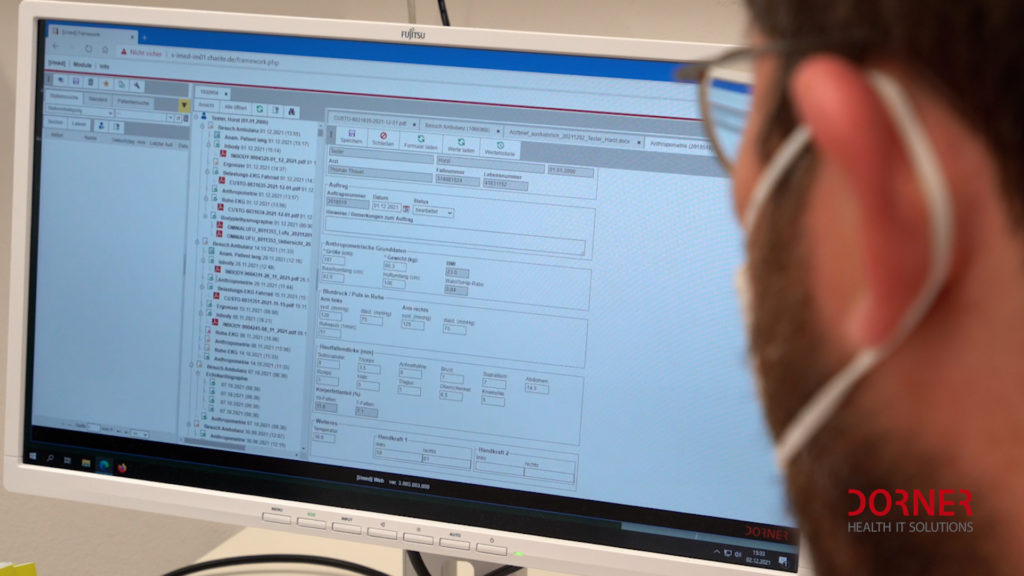
The big advantage is actually the clarity. We really have a complete listing of all visits in the past for every single patient. From each visit, you can view all the examinations that have been performed. We can view the whole thing chronologically, but we can also sort it by content, which means it's very intuitively designed and very quick to call up and open.

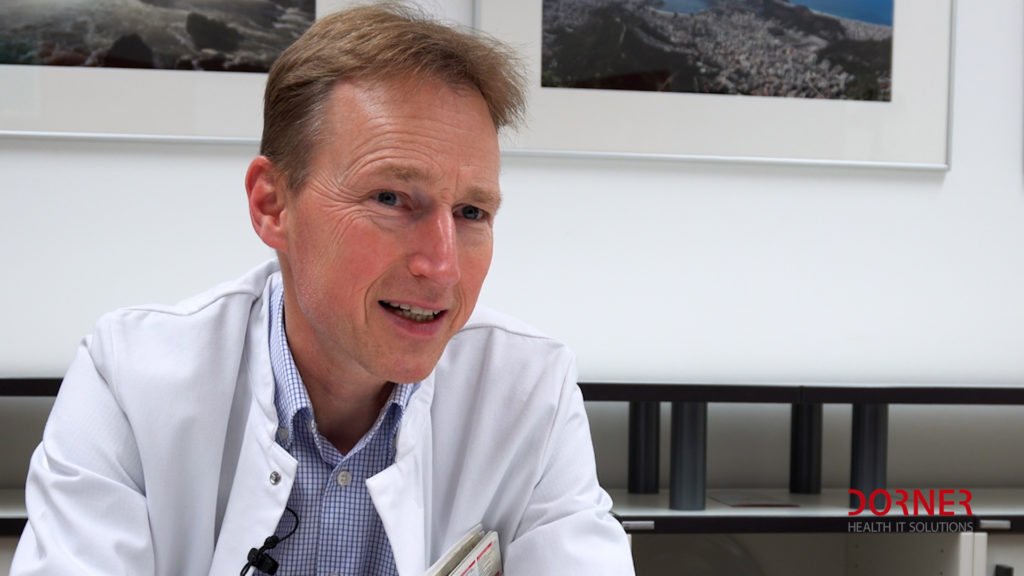
Dr. Thomas Thouet, Institute of Sports Medicine at the Charité

Our modular i/med Sport is used at the Institute of Sports Science and Sports Medicine at the Charité in Berlin. A standard software solution that is also used or can be used in exercise and occupational medicine, training sciences and similar institutes.

We simply have this hybrid situation in which, on the one hand, the Charité as a whole is dependent on SAP. We have to use that. That's quite clear. At the same time, however, we naturally wanted to have a system in our microcosm, so to speak, that is as flexible as possible for us and where we can connect our entire functional diagnostics. Where we also have our own design options. Both in terms of data input, but also in terms of data output and use of the data. And that's why we have our own "clinic information system" docked onto the SAP system. With this system, we can more or less design our own data management within the department.

Bernd Wolfarth from the Institute for Sports Medicine Charité

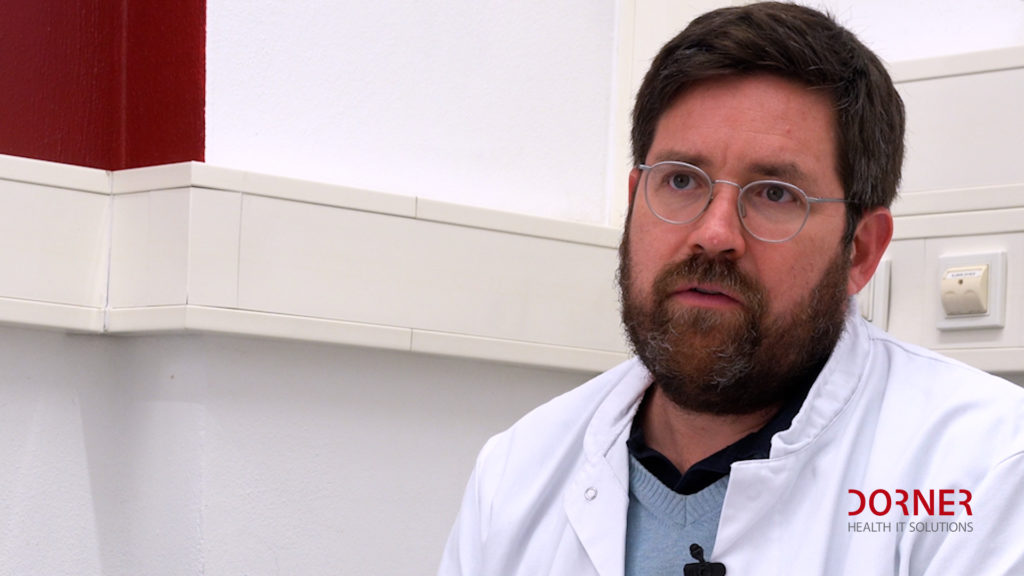
Prof. Dr. Bernd Wolfarth, Head of the Institute for Sports Medicine and Sports Science at the Charité, Berlin

An understandable concern, which we were able to realize with our [i/med] Sport: Starting with the extensive anamnesis required for sports medicine. Anyone who visits the sports medicine outpatient clinic at the Charité is given a tablet at the beginning of the examination on which the medical history is already recorded digitally. This data is automatically transferred to the digital patient file. There, they can not only be viewed by medical staff from anywhere, but the system also actively warns of any abnormalities:

For example, abnormalities in the family history. Sudden cardiac death below the age of 50 in the family history is an absolute warning signal and this is then also shown here again in a highlighted form, i.e. you can then also specifically address it again in the conversation and ask what actually happened.

A series of different examinations take place before the interview. Usually starting with anthropometry, in which data such as height, weight, blood pressure, body fat, etc. is collected manually. There is a smart mask for this, which automatically calculates the BMI, for example.
In order to simplify the work as much as possible and at the same time minimize sources of error, the devices at the institute were connected to i/med Sport. The order is sent to the device from the software and the results are also sent there. Optionally as PDF partial findings and/or as structured data. E.g. for the resting ECG. Or for exercise ECG. And also for spirometry. It makes no difference whether the device is connected directly via a bidirectional interface or has its own evaluation software to which the interface is implemented. And this even applies to data that is collected outside the institute.

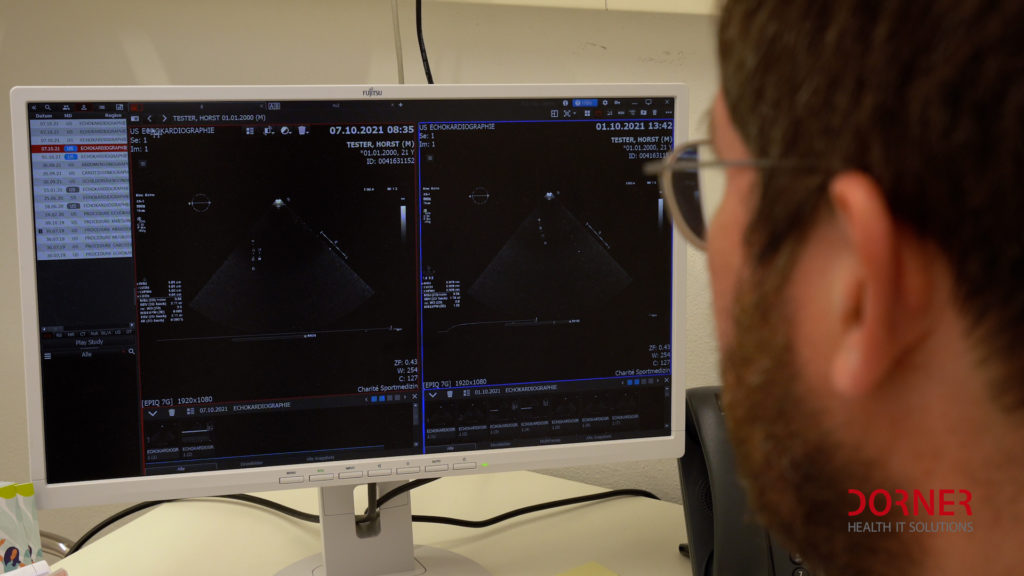
This is very convenient. In other words, we can start the Merlin Viewer from i/med, which gives us access to all the image data of the person sitting in front of us and we don't have to go back to SAP or any other HIS or PACS. This is really, ultimately a fully integrated system with access to all data: Laboratory data, image data, examination data from the institute and medical history data. That is very helpful.

Dr. Thomas Thouet

Ultraschall

Call up and compare ultrasound images directly from [i/med] Sport

In other words, an all-in-all flexible, intuitive and, last but not least, modular system that provides users at the Institute of Sports Medicine at the Charité in Berlin with an end-to-end digitized, paperless workflow. From the eAnamnese, a waiting room overview module, to the individual functional diagnostics with the respective device and software connections, all the way to billing (private billing, collective billing for senders and, last but not least, KBV-certified health insurance billing). And finally, the almost completely automated physician letter writing, which saves an enormous amount of time.

As far as the creation of doctor's letters is concerned: We are faster with this and that is already something that will also be an important quality factor in the future. Because we have all the information digitally, we can easily share it with doctors, hospitals and other healthcare providers. This is important to ensure the best possible care. In the future, we will probably have a common electronic record for all patients, and we are already very well prepared for that.

Prof. Dr. Bernd Wolfarth

imedSport

Collect all important information in one place and create a doctor's letter from it with one click

And as with all solutions based on our web-based DORNER Workflow Engine framework, you don't even have to be physically at the institute to use the system.

Ultimately, I have the option of logging directly into i/med via VPN from home using my browser, so that I can basically do everything that I would do here at my desk just as easily from home. Or sometimes, and this is really what sports medicine is all about, I might need to check a test result again on a Sunday morning at 8 or 9 a.m. because I might have a competition or match coming up in the afternoon. Of course, it's also very elegant if you open the tunnel view (or VPN access) to the Charité and can view it from home in two mouse clicks.

Dr. Thomas Thouet

Further information about i/med Sport

Learn more about our flexible IT solution for the Institute of Sports Medicine, Sports Science, Exercise and Occupational Medicine, the Training Sciences and at similar institutes .

Contact us today and convince yourself of the modular solution. Whether you are looking for a solution for the entire institute or want to digitize individual process steps (e.g. anamnesis or writing a doctor's letter)!

Brochure i/med Sport

DORNER on LinkedIn

Never miss a message again!