Pathology at the Limit—Is There More to Come?
Paper forms, media discontinuities, missing contextual information—this is still how the diagnostic process begins in many pathology departments. For pathologists, this means asking questions, searching, and waiting. At best, it results in a loss of time; at worst, diagnostic uncertainty.
This is exactly where the BMBF-funded HORUS project comes in: Virtual histology using micro-CT is set to become a reality in clinical practice—integrated into real-world workflows, supported by AI and digital process integration.
The DORNER Article – Experience Meets Innovation
For new technologies to be effective, a stable foundation is needed. This is where DORNER brings its more than 20 years of experience with the Workflow Engine to bear. This flexible web framework has been mapping complex medical processes for years—in projects such as ravenna and isendi, as well as now in HORUS.
The result: a system that not only transmits data but also intelligently controls processes.
Step 1: Order Creation – Digital, Structured, Context-Rich
A new case is being admitted to the clinic. Instead of handwritten forms, all data is entered digitally:
- Structured requirement data instead of free text
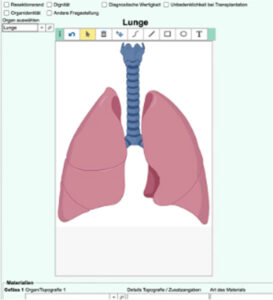
- Graphical location labels on organ diagrams (liver, lungs, etc.)
- Automatic Translation into Codes (SNOMED, LOINC)
- Previous findings, lab results, and AI-based summaries of doctors' notes are visible directly within the order
- Validation checks prevent missing information
👉 For pathologists, this means that all information is available in its entirety and in context right from the start.
Step 2: Order Transfer – Say Goodbye to Media Breaks
In the lab, the system handles the organization:
- The Order Monitor displays the status of all cases
- Samples are recorded by scanning a barcode
- Import all order data, including attachments —without any media breaks
- Automatic Assignment to a Processor
- Feedback on Micro-CT utilization directly within the system
👉 Result: Transparency from the very beginning.
Step 3: Order Processing – AI and Micro-CT in the Workflow
Now the diagnostic process begins. And this is where it becomes clear why digital workflows in pathology are more than just an IT gimmick:
- Micro-CT: Not available in real time → therefore, clear process integration with status updates and runtime data
- Interfaces enable:
- Order with all relevant data
- Structured Import of Findings
- Integration of the ImFusion Viewer for Image Analysis
- Semi-automated report generation assists pathologists with structured input forms and standard text templates
- AI-powered analyses complement traditional histology
👉 Pathologists work consistently within the same system—without any gaps or loss of information.
Step 4: Display of Findings and Feedback – Immediately Available at the Hospital
The diagnostic findings are also fed back just as smoothly:
- Digital Display of Findings for All Parties Involved
- Monitoring functions, such as for surgery appointments
- Structured Transmission of Medical Findings to the HIS
- Automatic coding (ICD, TNM, etc.) and transfer of diagnoses, scores, and performance data
👉 This means that the findings are not only documented but can also be put to immediate clinical use.
Conclusion: When Digitalization Really Helps
HORUS makes it clear: Workflow is more than just data routing. It’s about process intelligence —that is, what pathologists need, when they need it, in what form, and with what level of contextual detail.
With its Workflow Engine, DORNER provides a platform that seamlessly and intelligently integrates micro-CT, AI, and traditional histology.
The result: fewer follow-up questions, greater certainty, and better diagnostics.
Want to learn more?
Learn more about the HORUS project and our workflow solutions —or contact us directly. We look forward to hearing from you!